Sunday, April 29, 2012

Texas & Pacific's ten-wheeler 316


Now engine number 201 on the Texas State Railroad line, this 4-6-0 was built in 1901 by the A. L. Cooke Locomotive Works for freight service on the Texas & Pacific Railway.

In 1949, after 48 years of hard service, the Texas & Pacific sold number 316 to the Paris & Mt. Pleasant Railroad, a T. & P. subsidiary. In 1951 the locomotive was saved from the scrappers' torch by a remarkable lady who purchased the loco and, with help from the T. & P., donated it to the city of Abilene in honor of its 75th anniversary as a city. The venerable engine remained on display in Abilene at the Oscar Rose Park for many years, wearing the number 75 to symbolize the 75th Jubilee of the city.

In 1974 the citizens of Abilene donated the locomotive to the newly formed Texas State Railroad State Historical Park. After extensive repair and refurbishing the engine was again rolling down the rails to thrill a new generation of train passengers, deep in the heart of the East Texas piney woods.

Weight: 79 tons
Original boiler pressure: 200 psi (1379 kPa)
Ccurrent boiler pressure: 180 psi (1241 kPa)
Cylinder size: 20" x 26" (508 x 660 mm)
Trcative effort: 28,000 lbs force (125.6 kN).
Tender capacity: water: 5,350 US gallons (20,252 litres); oil: 2,500 US gallons (9464 litres).
Valve gear: Stephenson
Driving wheel diameter: 63" (1600 mm)

security planning for London Olympics includes evaluation of surface-to-air missile systems


Extract from MoD leaflet 
It's apparent that British officials are considering everything when it comes to the potential for Muslim terrorist attacks on the London Olympics and that memory is still strong of what happened at the Munich Olympics 40 years ago.

from the BBC website:-

The Ministry of Defence says it is evaluating sites for surface-to-air missiles for the Olympic Games, and could place them at residential flats. Residents at an estate in east London have received a leaflet saying soldiers could be placed there during the Games.

It says part of an air defence system might be based at a water tower on the estate, where 700 people live.
A spokesman said the MoD had not yet decided whether to deploy ground based air defence systems during the Games.

The leaflet states that members of the Armed Forces will be at the location for a military exercise in early May for between five and seven days, between 2 and 7 May. It goes on to say that there will be a "major national exercise" from 2 to 10 May to test the Armed Forces' capabilities to help the police provide security during the Olympics.And if the government decides to use the missiles during the Games, then the soldiers could be "operationally deployed for a period of up to two months this summer".

The MoD also says in the leaflet that the missiles will be manned by "fully trained, professional soldiers", will not pose a hazard to residents and the missiles "will only be authorised for active use following specific orders from the highest levels of government in response to a confirmed and extreme security threat".

The document also states that "having a 24/7 Armed Forces and police presence will improve your local security and will not make you a target for terrorists".

Lightning strikes a Continental airplane at the gate

 
You'll need to watch it more than once to see all of the action; it all happens in 10 seconds.  Note the distance of the clouds from the airport.
 
Three things to watch:
 
First the tail of the aircraft as the lightning bolt hits the vertical stabilizer (it happens fast)
 
Second view, watch the nose of  the aircraft where ground crew walk up to and under the airplane, then quickly retreat.
 
Third look just left of the nose gear. The brown square on the ground is a metal plate embedded in the concrete, with an access cover in it. The lightning strike exits the airplane onto the metal plate and sends the access cover flying through the air toward the tug on the far left where it lands harmlessly between the two vehicles.
 
(thanks to Bert for sending this in)

an elaborate color-light signal gantry


A set of F7 units at the front of an eastbound Chesapeake & Ohio freight train at Russell, Kentucky, in 1956.

'I like the sound of waves while I read a transpress nz book'


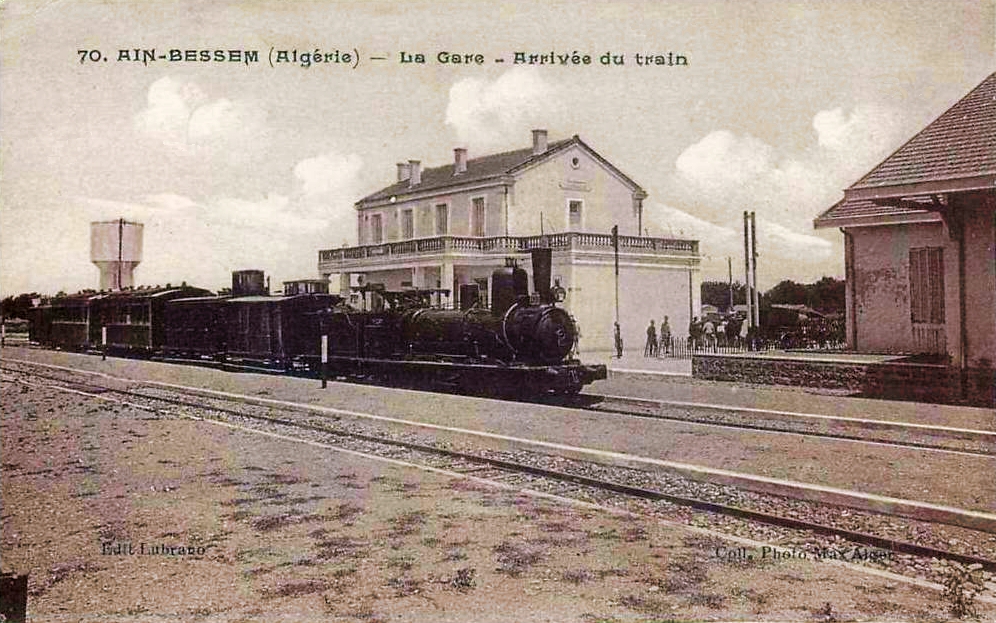
on Algeria's railways of old - 2


an Algerian Garratt for the 1055 mm gauge, built by the Société Franco-Belge in 1931 for the PLM in Algeria, a 4-8-2+2-8-4, 4 equal cylinders.
a bridge in the Chiffa Gorge near Blida
the other side of the bridge

another bridge in the area
"fortified station" (against the climate, warriors or both?) on the line from Oran to Colomb-Bechar
elevated line at Beni Saf port, 1947
a recent view at El Kantara from Google Earth
Mansourah / Bordj Bou Arreridj, maybe 1950s
Oran station - see separate post

a more recent view of Phillipeville station than the above
it could almost be somewhere in France
electric line between Bone (now Annaba) and Tébessa, as well as the mines of Oufnza and Kouif.
 

NZ military stamps, 1984


Stamps depicting NZ troops involvement in the Boer War, WW1 (scene in France), WW2 (scene in North Africa), and Korea/South East Asia (1950-1972).

1957 Plymouth Fury


Obviously imported from California: 2-door hardtop, 5-seater, 3,000 cc engine. (from NZ Classic Car Magazine)

on Algeria's railways of old - 1

Algeria's railways were built by the French in the colonial era which ended in 1962.  Today the majority of the North African country's 3,973 route km system is in standard gauge 1435 mm, but there is still over a quarter of it in the strange gauge of 1055 mm (3 ft 5.5"), a half inch less than the common 3 ft 6 inches.


the main Alger station


distant and closer view of the Aumale station

a visual inspection of the stricken near-new Qantas A380 after the number 2 engine exploded

These images of the A380 explosion on QF32 were released by the Australian Transport Safety Bureau. This picture shows damage to the inner fuel tank of the left wing. A total of 44 pictures here

A walk through the empty A380 following its (expensive) repairs and a chat with the captain as he points out the "exit wounds" on the plane from the day the engine failed on 4 November 2010: -


Dave Evans is not just any A380 captain - he’s the Check and Training Captain of the A380 Airbus, and he just happened to be working on the Qantas flagship plane Nancy Bird Walton in 2010 when the number two engine failed, sending debris at high velocity into random parts of the jet.

“It takes on its own life when these things happen,” Capt Evans said.

“Everything just went into slow motion. Some things I couldn’t recall doing; you just go into your responses - looking back at the flight information what we did all worked out well.”

Easy to say - but the end result is the plane landed safely, with a reasonably calm cabin.

Read more here: