Monday, November 22, 2010

Ford cars, mostly yesterday and some today


Freshly arrived from the distributor is this new coffee-table presentation of well-known cars (and a few pick-ups) from American Ford, many of which have come to NZ. Most photos are in colour and most are publicity shots, with some restored examples of older models. 160 pages in oversize format, hardcover.

Rimutaka Incline gold


This photo from the Keith Cullen collection and taken by Derek Cross, shows a double-headed steam train descending the famous Rimutaka Incline near the bottom of it at Cross Creek (the name had nothing to do with Derek Cross) and near the end of the operation of the Incline on 29 October 1955.

As well as the locomotives there are three Fell-type brake vans behind them. The house was a ganger's home about 400 metres from Cross Creek.

Today most of the gorse and broom visible in this photo has given way to regenerated native trees.

For more photos of steam on the Rimutaka Incline, see our book New Zealand 1950s Steam in Colour compiled from the Derek Cross collection.

Sunday, November 21, 2010

Glasgow Electric 50 years


This scene, of which we have a framed print on our office wall, was painted by famous illustrator/artist Terence Cuneo (1907-1996) in 1960.

The 'Glasgow Electric 50: 1960 - 2010' exhibition opened on Saturday 13 November for a period of two months at the Kelvingrove Art Gallery And Museum, Glasgow. The exhibition covers the history of electric commuter trains in Glasgow since they were introduced in 1960 with the iconic and much loved 'Blue Train', climaxing with the reopening of the Airdrie to Bathgate route.

A large collection of original items is in the exhibition such as timetables, posters, badges, postcards, promotional literature, books, transfers, model trains and pictures shown on a DVD player.

Terence Cuneo began his artistic career as an illustrator, but it was his work as a war artist which brought him national recognition. During WW2 while serving briefly with the Royal Engineers, Cuneo was the artist for the Illustrated London News in France. From 1941 he served as an official war artist, producing propaganda paintings for the Ministry of Information, and also illustrated the book How to Draw Tanks. In post war Britain, Cuneo became the establishment artist for much of the latter half of the twentieth century. As official artist at Queen Elizabeth II's coronation in 1953, his name was put before the public worldwide. He painted portraits, as well as landscapes and industry, but most famous are his railway scenes. His largest painting measuring 20 ft by 10 ft, commissioned by the Science Museum in 1967, was of the concourse at Waterloo Station in London. He was famous for putting a mouse in his paintings; this first appeared in 1953 and subsequently in most of his paintings thereafter. A statue to his memory at Waterloo Station was unveiled in October 2004.

exhibition 'Tintin, Hergé and trains' at the Hergé museum


This poster is for an exhibition of the famous comic book character with the trains that have been part of his adventures in various countries, now showing at the Musée Hergé at Louvain-la-Neuve in Belgium until 27 February next. A map of how to get there is included on the museum's website.

Comparison of space required for a railway line and a road


This photo by one of our directors (as usual, click for full version) of a coal train from the West Coast beginning its ascent of the Otira River Valley just below Aickens on the Midland Line demonstrates how little space is required for a railway line compared to a two lane road.

And a railway is far more fuel-efficient than trucks on a road, and presents no impediment to motorists. We've said that before haven't we? Well, perhaps if we and others say it often enough, just maybe Steven Joyce and the government will heed it.

early DC-3 artworks


Further to our post on the book for the 75th anniversary of the Douglas DC-3, here are two items from the early period of this aircraft. We think the American Airlines artwork is just before WW2 and the TWA advertisement is just after.

A large number of this aircraft used in WW2 made their way into civilian service after the war, including in New Zealand - details of most of them will be found in the book The Aircraft of Air New Zealand and Affiliates since 1940 by Paul Sheehan.

Saturday, November 20, 2010

a DSB poster from 1934 with a certain propheticality


This poster in the DSB (Danish State Railway) Museum in Odense dates from 1934 and the opening of the København S-Ban or city railway system.

It shows a motley collection of passengers, one of which looks rather like Der Führer of Germany, and someone following him is carrying a valise labelled Argentina, which of course is where many of Herr Hitler's top followers fled to in 1945.

The Copenhagen S-Ban system, like that of Wellington inaugurated 4 years later, is electrified in 1500 volts DC.

Thorpe-Bowker [New Zealand] Independent Bookshop of the year 2010


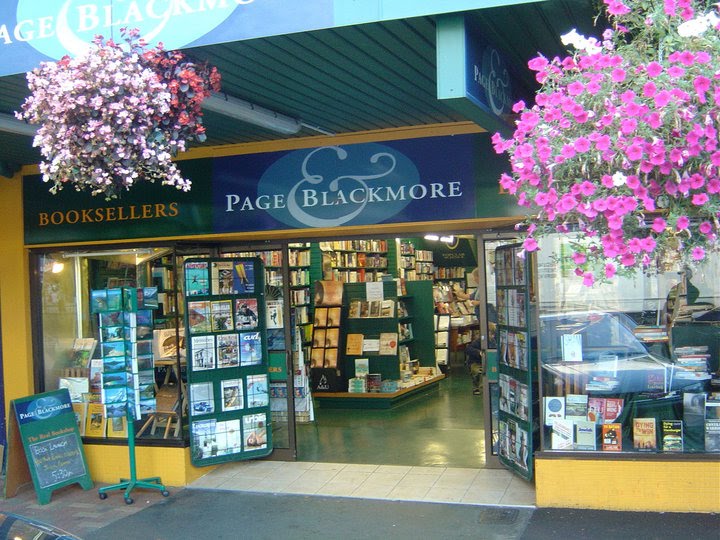
This is a little belated because the award, decided by both by Thorpe-Bowker and Booksellers NZ, was made nearly 3 months ago; but our congratulations to Page and Blackmore in Nelson for winning this. This shop stands out because its two principals have a good knowledge of a whole range of book subjects, have an excellent range of titles on their shelves and, of course, keep our titles in stock.

If you're passing through Nelson, pay this shop a visit.

Studholme Junction through the years


Returning one more time to the theme of the South Island Main Trunk, here are views of Studholme, or Studholme Junction as it was known until the Waimate Branch, which connected here, closed in 1966.

The Muir and Moodie view (a high res version of which was included in our book New Zealand Railway Memories compiled from the J.D. Mahoney collection) dates from 1906 and the second view is from June 1978. Other views are in the book New Zealand 1950s Steam in Colour compiled from the Derek Cross collection.

Today? Well as the Google satellite view shows, not much remains apart from the main line.


View Larger Map

Kestrel and Toroa in 1971


Here is another photo of the Auckland waterfront which was not included in the book New Zealand Maritime Images: the golden years. This shows both the Kestrel and the Toroa steam ferries on the left wharf and other craft, now history, at the centre wharf.